18 August 2026
The Science of Reading, Explained for Parents: Why Schools Are Changing How Kids Learn to Read
The Science of Reading, Explained for Parents: Why Schools Are Changing How Kids Learn to Read
posted on : 6 August 2026
Something unusual is happening in classrooms around the world. Schools are quietly rewriting how children are taught to read — and in the US, more than a dozen states have gone as far as banning a method teachers used for decades.
If you've heard teachers suddenly talking about "phonemes" and "decodable books" and wondered what changed, this is the story. It's called the science of reading, and it affects your child directly — whichever country and school system you're in.
This guide explains what that research says, why the old way failed so many children, and exactly what it means for you at home. No jargon, no sides — just what the evidence shows.
In this guide:
What Is the Science of Reading?
The science of reading is not a program or a brand — it is the accumulated evidence from neuroscience, psychology and education research about how children actually learn to read, and which teaching methods work best. Stanford literacy researcher Rebecca Silverman describes it as research converging on two essential ingredients: decoding (connecting letters to sounds) and language comprehension (understanding what the words mean) — you can read Stanford's overview here.
In plain words: children need to be taught how to crack the letter-sound code, step by step. Speaking comes naturally to almost every child. Reading never does — every reading brain has to be built.
That single fact is why this movement exists. At least 40 US states have now introduced science-of-reading legislation, and similar shifts are underway in the UK, Australia and India's NEP-era classrooms. Schools aren't following a fashion. They're following the evidence — and some hard numbers that became impossible to ignore.
Old Way vs What the Science Says: At a Glance
| The old way (balanced literacy / three-cueing) | What the evidence says | |
|---|---|---|
| Reading a new word | Guess from the picture, the first letter, or context | Sound it out letter by letter (c-a-t → cat) |
| Books for beginners | Predictable books ("I see a dog. I see a cat.") | Decodable books built from sounds already taught |
| "Sight words" | Memorise hundreds of words by shape | Words become automatic through sounding out |
| Order of teaching | Letters and sounds picked up "naturally" along the way | Planned, systematic sequence of sounds |
| A struggling reader | "Give it time — they'll bloom" | Act early — explicit help, straight away |
📌 Screenshot this table. If you only remember one thing: guessing is a habit that has to be untaught later — sounding out is the skill that lasts.
The Method Schools Are Walking Away From
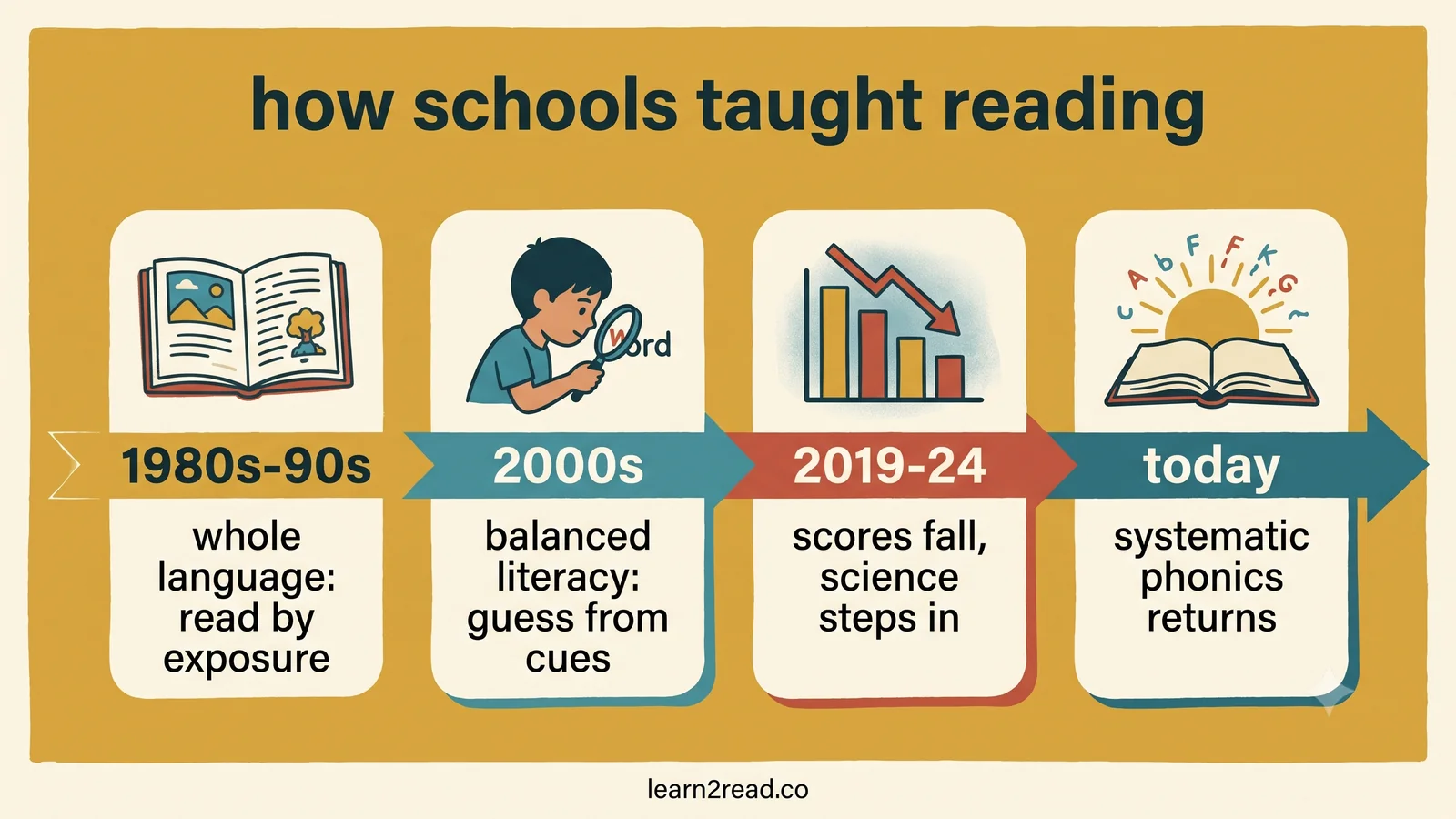
For roughly three decades, much of the English-speaking world taught reading through "balanced literacy," which in practice often meant a strategy called three-cueing: when a child hits an unknown word, prompt them to guess it — from the picture, the sentence, or the first letter.
It felt kind. It looked fluent. And for millions of children, it quietly failed — because guessing works in picture books and collapses the moment texts get harder and the pictures disappear.
The turning point was data. In the 2024 US national assessment (NAEP), 40% of fourth graders scored below even the basic reading level — the highest share in decades, with not a single state improving (Stateline's report has the numbers). More than a dozen states have now banned three-cueing outright, and Mississippi — an early adopter of phonics-first teaching — is held up as the model turnaround story.
One line from that report stays with every parent who reads it: a child's reading skill at the end of grade 3 predicts their likelihood of graduating from school. The stakes of the method are that real. (We've written about what those early years look like child-by-child in our reading milestones by age guide.)
To be fair to teachers: nobody was being careless. Balanced literacy drifted away from explicit phonics with good intentions — immersion in rich stories feels like it should be enough. The science simply showed it isn't, for most children.
Why Guessing Fails the Reading Brain
Here's the simple science. English has 170,000+ words in common use — no child can memorise them all as shapes. But English runs on about 44 sounds, and once a child can match letters to those sounds, they can unlock any word — including words they've never seen.
Something better happens next. Each time a child correctly sounds out a word a few times, the brain files it away permanently — and from then on they recognise it instantly, no sounding out needed. What looks like "reading by sight" in a strong reader was built by sounding out. Guessing builds no such file; it just builds faster guessers.
This is also the most heavily tested finding in reading research. The US National Reading Panel's landmark review concluded that systematic phonics instruction — teaching letter-sound relationships in a planned sequence — significantly outperforms unsystematic or no phonics (the report is here). Our plain-language guide to what phonics is and the full phonics sound chart of all 44 sounds show exactly what that sequence contains.
5 Questions to Ask Your Child's School
You don't need to interrogate anyone — one parent-teacher conversation tells you everything. Ask these, kindly:
- "How do you teach children to read new words?" — You want to hear: sound them out. A red flag: "we encourage them to use the picture and context."
- "Is there a planned sequence of sounds?" — Systematic phonics follows an order. "We cover letters as they come up" is the old way.
- "What books do beginners take home?" — Decodable books (matched to sounds taught) are the good answer; highly predictable repeat-after-me books are the red flag.
- "How do you handle a child who's falling behind?" — You want early, explicit, extra phonics help — not "let's wait and see how the year goes."
- "How will I know which sounds my child is learning?" — Good programs tell parents, because 10 minutes of practice at home multiplies everything.
📌 Save this list for your next school meeting — the answers matter more than any brochure.
And if the school's answers worry you, don't panic — children catch up fast when the method changes. That's most of what we do all day.
The Science of Reading at Home (10 Minutes a Day)
You can run this approach at your own kitchen table — no training required. The recipe our teachers use with thousands of families:
- Teach sounds, not letter names. "m says mmm" beats "that's em." Lowercase letters first — that's what books are made of.
- Follow a sequence. Start with s, a, t, p, i, n — those six sounds alone build dozens of words (sat, tap, pin, nap).
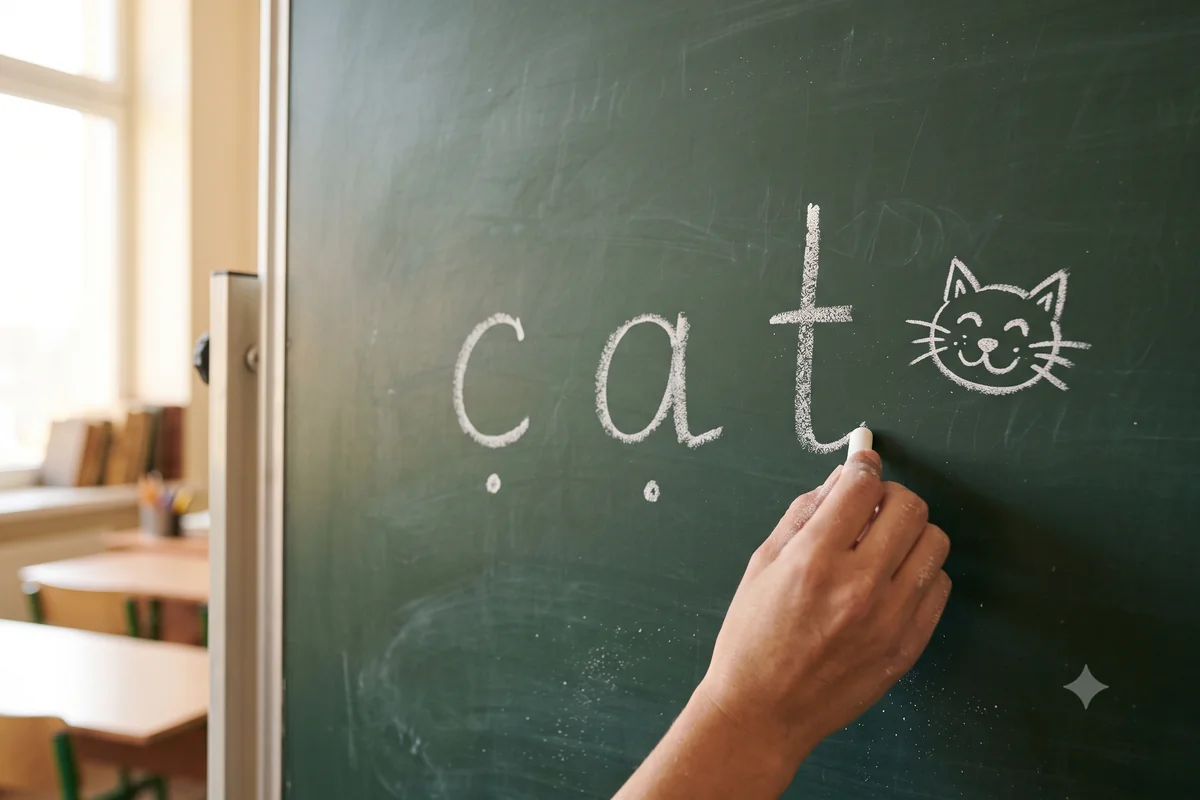
- Blend early. The magic skill is pushing sounds together: "c...a...t — cat!" Two minutes a day of blending games changes everything.
- Read decodable books, then celebrate. A child who reads a whole (tiny) book alone believes they are a reader. Belief does the rest.
- Keep the bedtime story sacred. Comprehension and vocabulary grow from the rich books you read to them — that never stops.
Learn2Read — a live online phonics program teaching children aged 3-12 across 35+ countries — has taught systematic synthetic phonics since day one, the exact approach this research points to. Our step-by-step guide to teaching phonics to preschoolers gives you the full home sequence.
FAQs: The Science of Reading
Is the science of reading the same as phonics? Not quite — phonics is the biggest piece of it, but not the whole. The science of reading covers everything research shows about learning to read: phonemic awareness (hearing sounds in words), systematic phonics, fluency, vocabulary and comprehension. Phonics is the engine; the others are the rest of the car.
My child's school still uses balanced literacy. Should I worry? Don't panic — supplement. Ask the five questions above, and run 10 minutes of daily letter-sound practice at home so your child gets systematic phonics somewhere. Children who get explicit phonics at home cope far better with guess-friendly classrooms than children who get none.
My child already learned to read by memorising books. Is that bad? It's common, and it's fixable — but do act. Memorisers often hit a wall around age 7-8 when texts outgrow their memory. Check whether your child can read a simple unfamiliar word (like "mip" or "fen") by sounding it out. If they can't, rebuild the phonics foundation now; it takes weeks, not years.
What are decodable books? Decodable books are beginner books written almost entirely from the letter-sounds a child has already been taught, so the child can genuinely read every word rather than guess. A child who has learned s, a, t, p, i, n can read "sat," "tap," "pin" — so their first decodable uses exactly those words. They're the training wheels of reading.
Did schools really teach reading "wrong" for decades? Many did, in good faith. Balanced literacy assumed children absorb the letter-sound code naturally through exposure — and some children do. But large studies, including the National Reading Panel's review, showed most children need the code taught explicitly and in order. The recent laws and curriculum changes are the correction.
What age does the science of reading apply to? The approach matters most from about ages 3 to 8 — sound play at 3-4, systematic letter-sound teaching from around 4-5, and fluency building through 7-8. Older struggling readers benefit from exactly the same method; it is never too late to teach the code properly.
Read Next
- Phonics vs Traditional Reading: What Actually Works for Early Learners? — the head-to-head version of this story.
- Reading Milestones by Age: What Your Child Should Do at 3-7 — check where your child is on the ladder.
- How to Choose a Phonics Program: A Parent's 10-Question Checklist — for when you're ready to act on all this.
Want your child taught the way the science says — by a live teacher who knows their name?
Book a Free Trial Class →
— The Learn2Read Team

Latest Posts
11 August 2026
Can AI Teach Your Child to Read? An Honest Answer for Parents (2026)
6 August 2026
The Science of Reading, Explained for Parents: Why Schools Are Changing How Kids Learn to Read
31 July 2026