18 August 2026
Reading Milestones by Age: What Your Child Should Do at 3, 4, 5, 6 and 7 (and When to Worry)
Reading Milestones by Age: What Your Child Should Do at 3, 4, 5, 6 and 7 (and When to Worry)
posted on : 28 July 2026
It usually happens at night. A cousin's post about her 4-year-old "reading chapter books," a parent-group message about some other child's certificate — and suddenly you're searching reading milestones by age at 11pm, heart beating a little faster than you'd like to admit.
Take a breath. Children learn to read across a wide range of timelines, and a child who isn't reading at 4 is almost always exactly where they should be.
This guide walks you through reading milestones at ages 3, 4, 5, 6 and 7 — what most children can typically do, the red flags that actually deserve attention, and the exact steps to take if something feels off. Save it; it will be useful for years.
In this guide:
What Are Reading Milestones — and Do Ages 3-7 Really Matter?
Reading milestones are the skills most children typically develop, in a predictable order, on the way to reading — from enjoying rhymes at 3 to sounding out new words at 6. They are signposts, not deadlines.
The order matters more than the exact age. A child who is 6 months "late" but moving through the stages in sequence is developing typically. A child who is stuck at one stage for a long time is the one who needs a closer look.
Why watch these years closely? A 2026 study by NWEA that followed more than 400,000 children found that only about 14% of children who start school among the lowest readers reach reading proficiency by grade 3 — but the same researchers stress that early help, in the years this guide covers, is exactly what changes that path. Noticing early is not about panic. It's about power.
Reading Milestones at a Glance: Ages 3 to 7
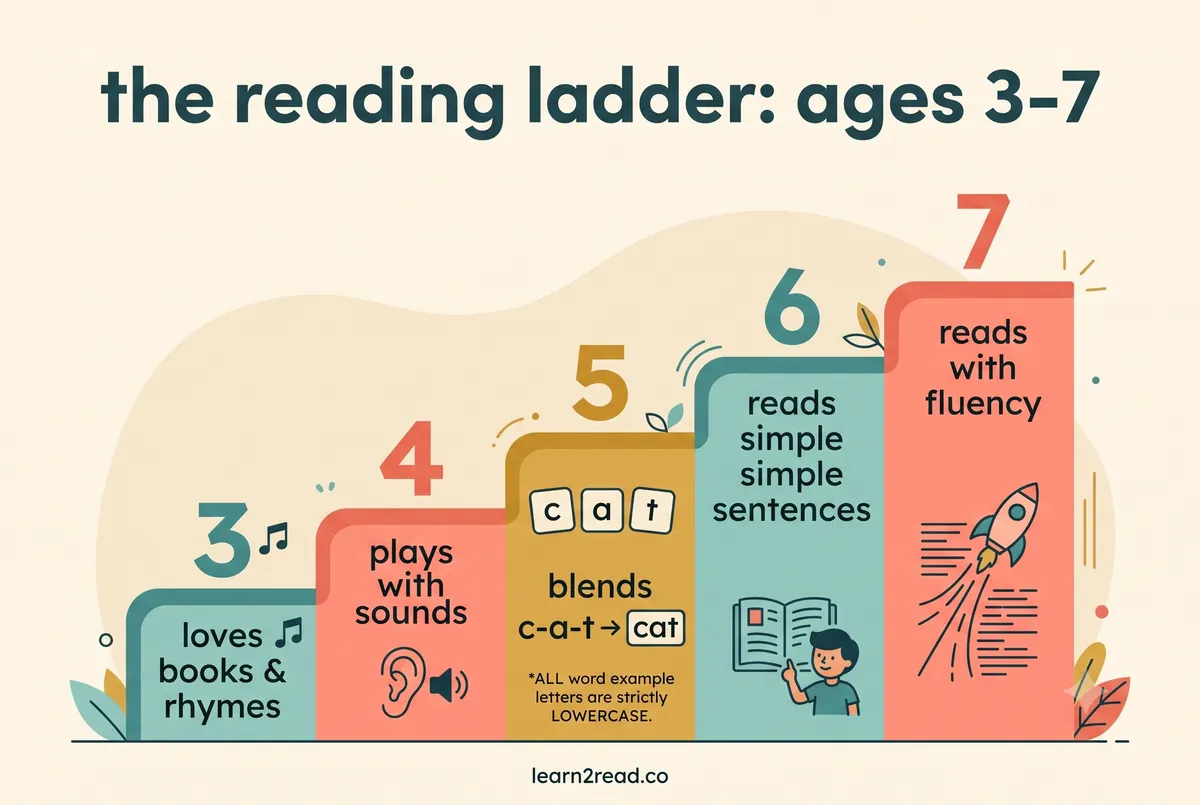
Most children can typically do these things at each age. "Typically" is the key word — a range of 6-12 months around each milestone is normal.
| Age | Most children typically... |
|---|---|
| 3 | Love being read to; "pretend read" favourite books from memory; join in rhymes and songs; hold a book the right way up and turn pages; may spot the first letter of their name |
| 4 | Notice and enjoy rhyme (cat-hat-bat); clap syllables in words; recognise several letters, especially from their own name; "read" familiar logos and signs; retell a favourite story in their own words |
| 5 | Name most letters and give many of their sounds; hear the first sound in a word ("sun starts with sss"); begin blending sounds into words (c-a-t → cat) once taught; write some recognisable letters; read a few familiar words |
| 6 | Sound out new short words; recognise a growing set of common words instantly; read simple sentences and early books aloud (slowly is fine); rely less on pictures; spell simple words the way they sound |
| 7 | Read longer texts with growing speed and expression; tackle two-syllable words; notice and fix their own mistakes; retell what they read; begin reading silently for pleasure |
📌 Screenshot this table. It answers the question every parent group argues about — and it's worth re-checking each birthday.
(School names for these ages differ around the world — age 5 is "kindergarten" in the US, "Reception" in the UK, "UKG" in India. The skills follow the age, not the class name.)
Age 3: The Sound Collector
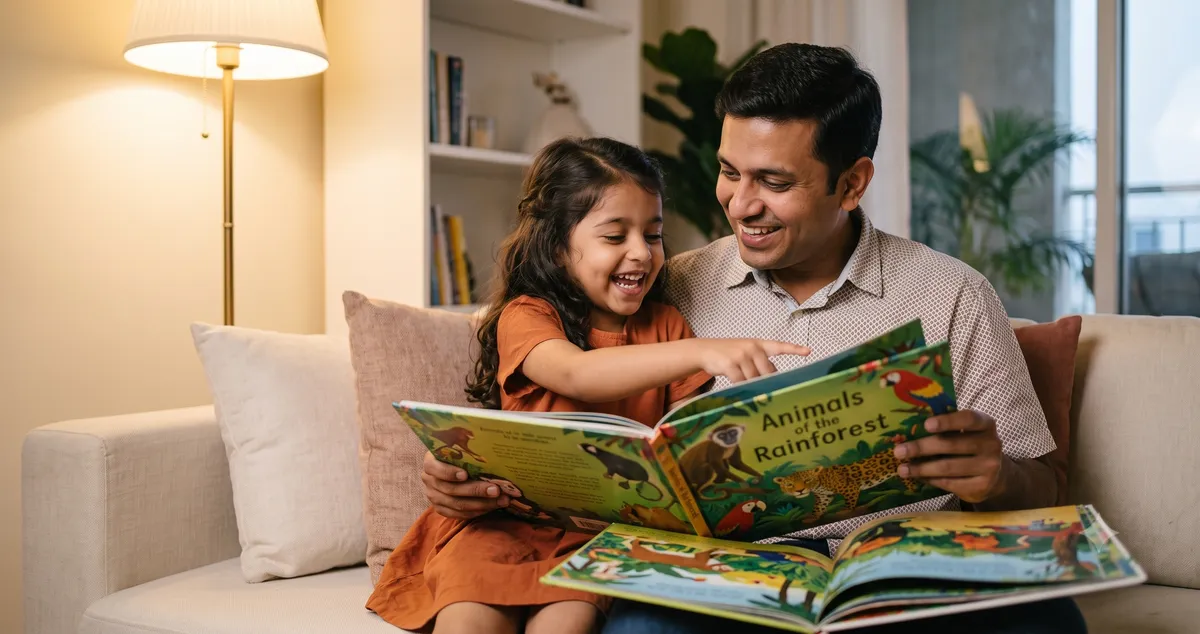
At 3, reading has almost nothing to do with letters — it is about falling in love with books and collecting the sounds of language. Rhymes, songs and being read to are literally building the brain's reading wiring.
What you'll typically see: a demand for the same book every night (repetition is learning, not laziness), joining in with "...and the wolf went huff and puff," pretend-reading to a teddy, and zero interest in sitting still for long. All of this is on track.
How to help this year: read aloud daily, even for 10 minutes. A 2019 Ohio State University study found that children who are read five books a day enter school having heard about 1.4 million more words than children who are never read to (the study is here). One bedtime story at a time is how that gap is built — in your child's favour.
Age 4: The Sound Detective
At 4, most children start noticing that words are made of sounds — the single strongest predictor that reading will come smoothly. Teachers call this phonological awareness: the ability to hear rhymes, syllables and beginning sounds.
What you'll typically see: delight in silly rhymes ("moon-spoon-BALLOON!"), clapping the beats in el-e-phant, spotting "their" letter on shop signs, and retelling stories with dramatic flair (and creative edits).
How to help this year: play sound games in dead time — the school run, the bath, the queue. "I spy something that starts with mmm." "What rhymes with dog?" Two minutes at a time, no worksheets. If they know some letters, always use the sound (mmm), not just the name (em) — sounds are what reading is built from.
Age 5: The Code Breaker
Age 5 is when most children are developmentally ready to crack the code — connecting letters to sounds and blending them into real words. This is the year phonics instruction typically begins in schools around the world.
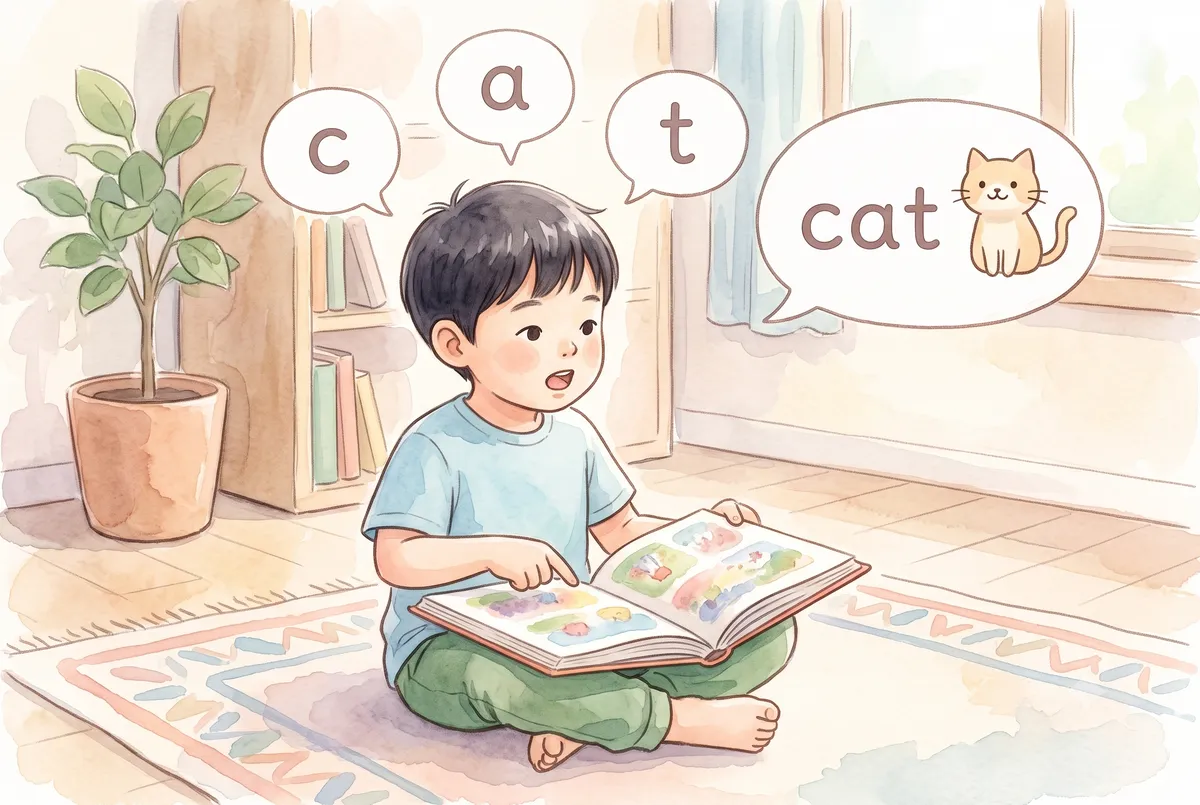
What you'll typically see: naming most letters, giving the sounds of many ("s says sss"), stretching a word out ("c...a...t... cat!"), writing wobbly-but-recognisable letters, and enormous pride the first time they read a word nobody told them.
English has about 44 sounds but only 26 letters, which is why children need to be taught the code explicitly rather than left to guess — our phonics sound chart with all 44 sounds shows exactly what they'll learn and in what order.
How to help this year: 10 minutes of letter-sound play a day beats an hour on Sunday — across 35+ countries, our Learn2Read teachers see daily-10-minute children overtake weekly-marathon children again and again. Start with s, a, t, p, i, n — those six sounds alone build dozens of words (sat, tap, pin, nap...).
Age 6: The Word Builder
At 6, most children shift from sounding out slowly to genuinely reading — decoding new words, recognising common ones instantly, and reading whole sentences aloud. Slow and steady is still completely normal here.
What you'll typically see: finger under each word, lips moving, triumphant announcements ("this says the shop is open!"), phonetic spelling in birthday cards ("hapy brthday"), and less peeking at the pictures for clues.
How to help this year: listen to them read a little every day, and when they get stuck, say "sound it out" before you tell them the word. Struggle-then-success is how the brain files a word away. Keep your own read-aloud going too — their listening level is still years ahead of their reading level, and stories above their reading level grow vocabulary.
Age 7: The Storyteller
By 7, most children read with growing fluency — smoother, faster, with expression — and the big shift begins: from learning to read to reading to learn. Reading researchers describe this whole progression, from pre-reader to fluent reader, in stages you can read more about at Reading Rockets.
What you'll typically see: longer books read over several sittings, two-syllable words tackled without panic, self-correction ("the horse ran... no wait, rode"), opinions about characters, and sometimes silent reading by torchlight after lights-out. (Officially you should stop this. Unofficially, celebrate.)
How to help this year: feed the habit. Library trips, book series (series are fluency machines — same characters, rising confidence), and 15 minutes of anything-they-love reading daily. Comics count. Recipe instructions count.
When to Worry: Red Flags at Each Age
One item from this table alone is rarely a concern; a cluster of them, persisting for months despite support, is worth acting on. Trust the pattern, not a single bad week.
| Age | Talk to your child's teacher or pediatrician if your child... |
|---|---|
| 3 | Shows no interest in books at all; isn't joining short words into phrases; often seems not to hear you (repeated ear infections matter here) |
| 4 | Can't notice or enjoy rhyme at all; recognises no letters, not even from their name; is hard for strangers to understand; can't retell a familiar story |
| 5 | Can't hear the first sound of a word; knows fewer than half the letters despite regular practice; letter-sound pairs won't "stick" week after week |
| 6 | Guesses words from pictures instead of sounding out; can't blend c-a-t into cat; avoids reading or melts down when it's time; reading feels like pure memorising |
| 7 | Still reads word-by-word with huge effort; can't retain common words seen hundreds of times; spelling looks random; can't tell you what a page was about |
Two honest notes. Letter reversals (b/d, was/saw) are typical until around age 7 — alone, they are not a dyslexia diagnosis. And a family history of reading difficulty is a genuine reason to watch more closely and act sooner, not a sentence; if several flags sound familiar, your pediatrician and school can arrange a proper assessment. The CDC's developmental milestones are a good general checkpoint for speech and language alongside this table.
What to Do if Your Child Seems Behind
Start this week, start small, and start with sounds — not with more pressure. Here is the order that works:
- Rule out ears and eyes first. A child who can't hear sound differences or see print clearly can't learn phonics from them. A quick hearing and vision check eliminates the most fixable causes.
- Shrink the dose, raise the frequency. 10 focused minutes daily beats a weekly hour that ends in tears — for the child and for you.
- Go back to sounds, not word-memorising. If blending is shaky, more flashcards won't help. Rebuild the base: rhyme games, first-sound games, then letters. Our guide to what phonics is and how it works shows the sequence.
- Follow a system, not random worksheets. The National Reading Panel's landmark review found that systematic phonics — teaching letter-sound relationships in a planned order — significantly improves children's reading (report here). Random apps and mixed methods are how children get confused.
- Protect story time. The moment reading practice becomes punishment, motivation dies. Keep one daily book that is pure pleasure, zero testing.
- Get skilled help early — not "let's wait and see." That NWEA finding cuts both ways: children who get help in these early years are the ones who catch up. Structured, live teaching a few times a week changes trajectories.
At Learn2Read — a live online phonics program where trained teachers work with children aged 3-12 across 35+ countries — catching up is most of what we do. If you'd like an expert to simply look at where your child is and tell you honestly, book a free trial class; the assessment alone is worth the 60 minutes.
FAQs: Reading Milestones by Age
Should my 3-year-old be able to read? No — reading at 3 is the exception, not the expectation. At age 3, the milestones that matter are loving books, joining in rhymes, and pretend-reading from memory. These build the sound awareness that real reading is constructed from at ages 5-6. If your 3-year-old shows zero interest in books, gently increase read-aloud time rather than starting letters.
At what age do most children start actually reading words? Most children begin genuinely reading words — blending sounds like c-a-t into "cat" — between ages 5 and 6, once they've been explicitly taught letter sounds. Some start at 4, some closer to 7, and within that range the starting age doesn't predict how strong a reader they'll eventually become.
My child memorises books and "reads" them back. Is that real reading? It's not decoding, but it is a healthy and normal pre-reading stage called pretend reading. It shows your child understands how books work and wants to be a reader. To nudge them toward real reading, run your finger under words as you read and occasionally point out first sounds — "look, pig starts with p."
Is it normal for a 6-year-old to still read slowly? Yes — slow, effortful, finger-under-the-word reading is exactly what age 6 typically looks like. Speed (fluency) usually arrives around age 7, after enough successful practice. Worry less about pace and more about method: a 6-year-old who sounds words out slowly is on track; one who only guesses from pictures needs phonics support.
My child writes letters backwards. Is that dyslexia? On its own, no. Most children reverse letters like b and d until around age 7 — it's a typical stage of learning symbols, not a diagnosis. Dyslexia concerns arise from a cluster of persistent signs: trouble hearing sounds in words, letter-sound links that won't stick, and very effortful reading despite good teaching. If that cluster sounds familiar, ask your school or pediatrician about an assessment.
Can I teach my child to read at home, or should I wait for school? You can absolutely start at home — 10 minutes a day of sound games and letter sounds at ages 4-5 gives children a real head start, and no teaching degree is required. The keys are using letter sounds (sss, not "es"), lowercase letters, and a systematic order. If you'd rather have a trained teacher guide it live, that's exactly what Learn2Read's classes are built for.
Read Next
- Is Your Child Ready for School? A 12-Point School Readiness Checklist (Ages 3-5) — because milestones and school readiness go hand in hand.
- When Should Phonics Be Taught to Kids? — the natural next question once you know the milestones.
- How to Make Your Child Love Reading (and Why So Many Kids Quit by Age 8) — skills get them reading; love keeps them reading.
Wondering where your child really is on this ladder? A Learn2Read teacher can tell you in one live session — kindly, honestly, and with a plan.
Book a Free Trial Class →
— The Learn2Read Team

Latest Posts
11 August 2026
Can AI Teach Your Child to Read? An Honest Answer for Parents (2026)
6 August 2026
The Science of Reading, Explained for Parents: Why Schools Are Changing How Kids Learn to Read
31 July 2026